
21 Practical Ways to Reignite Creativity
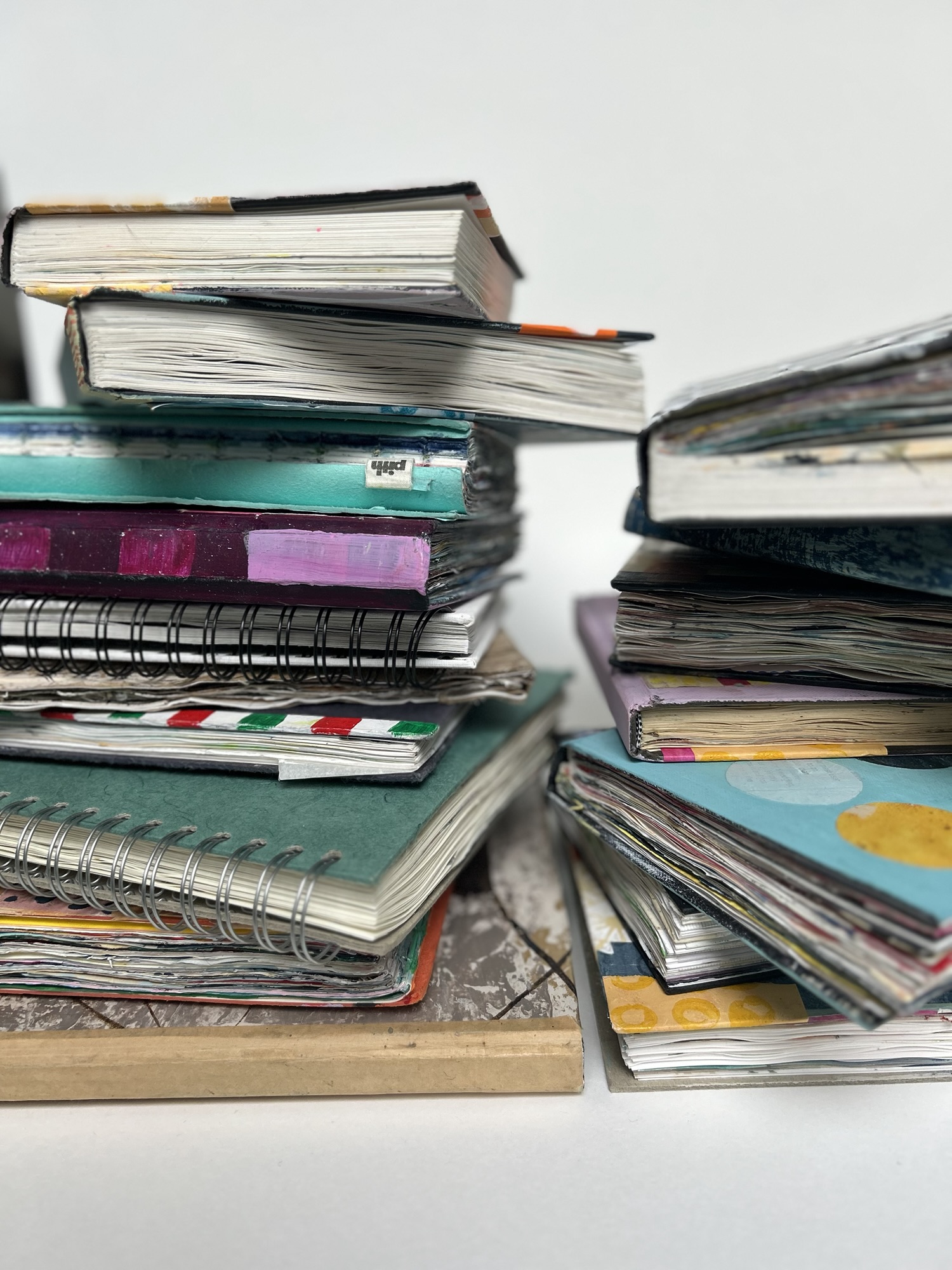
Every creative person hits periods where ideas feel distant and the studio feels heavy. Well, that’s what I’ve been telling myself every day for months now and whilst I know it is true it doesn’t make it any easier to deal with. So, over the past few weeks I’ve been going back through my old sketchbooks as I often scribble journal pages about how I’m feeling and I knew I’d jotted down notes on things that worked (or didn’t) when I was feeling low. I was surprised by how many different prompts I’d captured – little notes to my future self so I thought I’d bring them all into one place as a reminder.
Tidy the Studio
My studio constantly sits somewhere between chaos and order. When it tips too far into mess and I can’t find what I need, I know it’s time to reset. A good tidy is surprisingly powerful — it clears physical space but also mental space. It makes me feel like I’m doing something, even if that something is a way to avoid picking up a pencil or paintbrush. And as a bonus, I usually rediscover things I’ve forgotten about that spark new ideas.
Make Junk Journals
Recently I’ve started making sketchbooks from “junk” — old packing paper (smoothed and ironed), envelopes, magazine pages, anything really. There’s something freeing about working on paper that cost nothing.
Plus, most of these surfaces already have some kind of marks, textures, or print you can respond to. Even the window in an envelope can push you somewhere unexpected.


Make Backgrounds
I have mixed feelings on this one but often when I’m a bit low, I just take big sheets of cartridge paper and create interesting backgrounds for future paintings. There’s no pressure, just movement and mark-making. And my thinking is that they can be useful for future paintings.
Most of the time this works but just a warning – I do have a few where I’ve ended up hanging on to the background because I fell in love with something about it.

Make Lists
I love a ‘to do’ list. There is something so satisfying about ticking off tasks. But recently I’ve started a ‘Things that make me happy’ list. It sounds a bit weird but if you’ve had a tough time, and we all have challenges in our lives, then this can be a great reminder of stuff that just brings you a bit of joy. I’m also a fan of other lists – ‘ideas for new projects’, ‘things to learn’, materials to try, etc
Rework Compositions You Already Love
I often revisit compositions that have worked for me before and reinterpret them — changing colour palettes or reversing light and dark. It gets me working without the pressure of inventing something completely new, and often leads to unexpected ideas.


Give Yourself Permission to Experiment
The easiest way for me to avoid focusing on results and that desire to create a finished piece is to give myself permission to experiment. This might be taking a tool or material I haven’t used before or haven’t used for a long time and just play to see what marks it makes. Watching paint behave on its own can be strangely mesmerising.
Finish Things Off
Not unfinished paintings — that can feel stressful. But I always have some finished paintings in the studio that I haven’t got round to adding isolation coats, varnish or wax so getting these done can can feel productive and satisfying.
Learn Something New
A bit like experimenting this frees me up from results but its more structured. I’m sure most artists have a long list of things they would like to try and learn. No matter how many I tick off I always seem to have added more but unlike ‘to do’ lists I’m comfortable that I’ll never get to the end of this list.
Spend Time with Your Work
If my confidence is low, I often take a few hours to spend time with my paintings. It’s interesting to really look at pieces I like, taking notes on why I like these – what’s working? What makes it different? Why do I like this? Or, even pieces that I don’t connect with, sometimes seeing the faults is easier, although I need to careful with this as it can reinforce negative mind talk.
This is particularly helpful exercise when I’ve had a long break from painting.
Create a List of Titles You Like
The jury is still out on this one as it’s a very recent thing that I’m trying. But I’ve started writing lists of titles that I like with the idea that I take 2-3 of them and play around to see what ideas they spark.
Colour Swatching
When I find myself starring at a blank page with no ideas I start mixing paint and playing around with colour combinations. It’s also a useful way to shake things up as I have a tendency to fall back on my favourites too often. I just need to remember to -scribble down rough ratios so I can recreate them later.

Slow Down
I need to remind myself to slow down, forget about results and just enjoy the process. I do have a tendency to worry about getting stuff done so it’s helpful to take some time to just stop and think. In these pauses I often find that new ideas emerge.
Take a Walk

I’m lucky to live near the sea. Fresh air and movement helps me to reset. For many people this is about walking in fields or woods, for me it’s definitely something about the rhythm of the sea that brings calm but can also leave me feeling completely energised.
Gather Inspiration
My phone is full of random photos — peeling paint, crumbling walls, boats, fishing gear, sunrises. I often use Canva to turn these into printed grids to use on low-energy days.


Journal
I have read ‘The Artists Way’ but it didn’t work for me, too much God and too American in tone. My day journal tends to be more of a list of appointments and things to do. I’m not a natural journaller but when I’m struggling this can really help. It gets all my negative thoughts out of my head. I just have to remind myself why those negative thoughts aren’t true.
Collage
When painting feels too demanding, collage is accessible and playful. I used to make grid journals while travelling for work, and revisiting them recently gave me loads of composition ideas. If you’re interested in giving grid journals a go check out my blog post from December 2022.
Making collage papers is also one of my “go to’s” on uninspired days. They don’t require any planning, and I’ve found that even the ugly pages can come in useful when you look at them at a later date.

Return to Craft
Before I started painting, I spend a lot of time doing all sorts of crafts. Handmade greetings cards were and still are a favourite but I also created wire sculptures. I tried my hand at felting. I sewed. I knitted. I took pottery classes. I turned my hand to shell art. I got messy with paper mache. In fact if you name a craft I’ve probably tried it.
As a result, my studio is packed with boxes of materials and tools that I haven’t used for years. So, when I’m feeling stuck I go back to one of these and through myself into something different for a few days.


Immerse Yourself in a Good Book
For me this is usually an art book. I have a great second-hand bookstore near me so I often buy books of artists I’m unfamiliar with as well as my favourites. I have also started reading books on creativity in general which makes me feel like I’m moving forward even when I’m having a dry phase.
Copy, copy, copy
I often take a picture of a painting I love and copy it. Usually, I start off quite literal but deliberately change direction.
It’s one of the best ways to learn technique and appreciate the skill behind work that looks “simple” (which is usually the hardest to recreate).


Set Yourself Limits/Constraints
The blank page or canvas can be daunting, especially when I’m low on inspiration so limiting my options can really help. I learnt this from Cheryl at Insight Creative as a few of the prompts on her 30 day sketchbook challenge are working with limitations – limited colours, limited time, limited number of marks, etc. Restrictions can be surprisingly freeing.
Create a “Rescue Box”
Recently I’ve started to pull together ideas for a “rescue box”. At the moment it’s still just in list form but I’m starting to pull together materials that I’m hoping will be helpful when I’m not feeling it. So far ideas I have are – photos that I’m drawn to, pieces of collage paper that I love, some old sketchbook pages that I thought might translate into paintings, ideas for colour palettes, found objects that interest me. But any ideas you have ping them over!
If you have ideas for what should go in one, I’d love to hear them.
Final Thought
Being uninspired isn’t failure — it’s part of the cycle. I’m learning that creativity isn’t about constant output. I am having to remind myself that it’s about staying curious, staying open, and staying gentle with yourself until the spark returns.
2 responses to “When Inspiration Runs Dry:”
I write letters to my daughter explaining the book Im writing as though it is finished. That way I am forced to express the vision without pause. What emerges is the hundred ideas in the way of the work required to finish. Or start. Or remember what I wanted before I started writing. I used to photograph my unfinished paintings and take the photos with me while I was away from the studio. As though I missed them. I’d see their future. The version I could walk away from without taking a photo. Your words are inspiring. As you have always been.
I love the idea of writing letters set in the future I just find it awkward but I need to try this again.
When I, struggling with a piece I always take a photo and put it on my phone as my screensaver. It’s amazing how just catching a glance every now and then can help you think of ways to resolve it.